


The course creator offers a $1,000 program consisting of ten modules, lengthy videos, workbooks, bonuses, and a private group. The customers come with high expectations. The desired outcome is to launch a business venture, enhance a skill, get clients, change careers, etc.
But soon the buyer experiences information overload. Two lessons, three files, and they are behind already. The group forum is full of questions. Some customers require feedback, some – new lessons, some - less material. The creator continues to load the offer with lessons to justify the price tag.
There is a good reason for a $1,000 course. If the customer requires only one particular skill and knows the exact process and timeframe, such a course is possible. But most courses do not meet these criteria. They cover habit-building, entrepreneurship, software mastery, copywriting, design, marketing, career change, and other fast-changing topics. Customers require practice, correction, examples, and constant guidance.
Here, the $99 membership is the perfect tool for the task. It lowers the barrier to entry, gives customers the time to apply the knowledge, and allows the creator to fine-tune their offer each month.
The good membership keeps the customers engaged without overloading them with material.
What Is the Problem With the $1,000 Course
The high price exerts additional psychological pressure before the purchase of the first lesson. The sales page promises the full system. The dashboard contains many hours of training. On the first day, the buyer finds himself lagging behind because the course requires focus, time, and confidence.
Many $1,000 programs equate quantity with quality
They have many more modules, additional interviews, templates, and additional calls. This offer is quite substantial; however, the process is very confusing. For instance, if a person who buys something from you just needs one thing done, they now have to make twenty decisions.
The high price means time too
The busy learner has a job, kids, clients, or college. Five-hour modules compete for their attention with work and family duties. If the program requires 10 peaceful hours to show any results to the buyer, most buyers will silently stop.
The support becomes an additional issue
The buyer, who paid a lot, requires answers. The creator has to monitor the group, respond to messages, hold calls, evaluate the work, and resolve buyers' doubts. If the course is popular and brings in steady sales, support increases faster than the creator expected. A high price helps finance the course launch, but delivery requires considerable effort.
The content goes out of date fast
The interface of the tools changes. Platform policies change. The examples become irrelevant. After six months, the program looks outdated despite its success at launch. The creator should choose: to remake the program, to add more lessons, or let the buyers use outdated material.
The high price and the long course mean debt
The buyer pays a lot of money, so they feel guilty when they cannot complete all the assignments. Guilt kills any desire to learn. Buyers need actions, feedback, and little achievements. The $1,000 course sets them up for a huge task before they see any valuable results. This gap prevents referrals and future launches. Buyers praise courses that helped them act. They stay quiet about courses that made them feel late, confused, or alone after week one and skip the upsell.
Why a $99 Membership Fits Better
$99 membership fits adult learning well. Many adults do not require such a significant amount of information to be transferred at once. Adults need structure, tasks, feedback, and a reason to come back next week.
A smaller price changes the buyer's mindset. While paying $99, they need an offering that works and provides benefits, but it is easier for them than paying $1,000. They try the first task, ask the first question, and evaluate an offering by its effectiveness rather than its library size.
A membership allows the creator to provide information in small portions. It is much better than providing a large module of lessons. The buyer studies and applies them while they are still fresh in their mind. The creator understands which parts are difficult for the learner and adjusts the next lesson accordingly.
Membership fits updates nicely. When the platform introduces changes in a feature, the creator makes a video update or a new checklist for members. The offering evolves continuously as people use it.
Membership allows flexibility. Some members complete the task within a week, others within a month. It is typical for a course to push people through one process. Membership allows having structure without imposing the same pace.
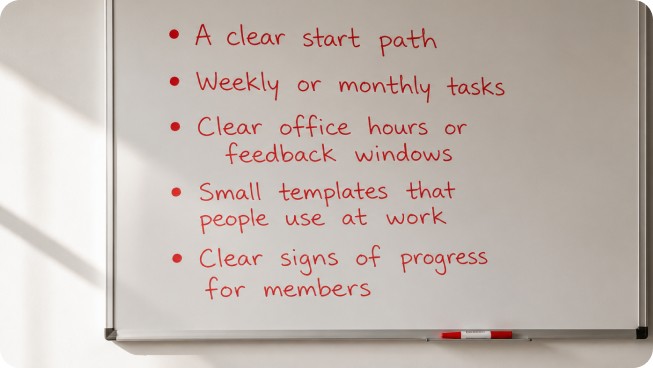
Membership provides good value due to rhythm:
-
A clear start path
-
Weekly or monthly tasks
-
Clear office hours or feedback windows
-
Small templates that people use at work
-
Clear signs of progress for members
A membership offers good opportunities for the creator. Instead of pursuing big launches, they receive a stable revenue stream based on product usage. Retention becomes the evidence of success. Members continue working with the offering because they receive benefits and expect more next month.
Signs a Course Should Become a Membership
Not every topic fits a course. Something fixed, consistent, or short-term can easily be done once and for all. There are, however, topics where time, repetitions, and assistance are required. Such topics are membership candidates.
A course becomes a candidate for a membership model when buyers start requesting additional help long after the last module is over. If they complete all modules but still request reviews, examples, calls, or updated templates, then such a course is actually a support program plus a course.
Here are the signals to look for:
-
Buyers have the same recurring follow-up questions each month
-
Topic changes frequently
-
Student requires feedback on their work
-
Result depends on repetitions over time
-
Learner quits because of the course's size
-
Community gives value higher than videos
-
Buyer asks for assistance in a new case after completing the course
The above topics are typical for marketing, content creation, design, coaching, language learning, software skills, and business building. A learner doesn't learn the skill through watching lessons once. They need to try, fail, edit, ask, and try again.
A creator himself should pay attention to support patterns. If buyers frequently send screenshots, drafts, plans, or other materials, they need feedback loops. A simple dashboard can't handle that. Membership will help them structure their support process more effectively.
Completion rates are an interesting indicator too. If many buyers complete only two of five modules, then the course's requirements were probably too high. Membership will help to divide the journey into smaller actions.
The most powerful signal is found in consumers' actions. When individuals request calls, samples, and information more often than video modules, it suggests that your offer is already considered a membership.

How to Structure the Membership
Let’s look at the go-to plan for structuring your future membership.
Begin with one promise
The membership must provide members with one clear outcome, such as producing better lessons, establishing client systems, enhancing design quality, or using a tool more easily. A broader promise leads to an untidy library. A narrow promise means a path.
The first month is about actions
Fresh members require a starting page, brief orientation and one task they can perform this week. Provide them with the fastest possible win. This win will prove that the membership works.
Use this structure:
-
Starting page with the goal and the first task
-
Core path with four to six lessons
-
Task list for each stage
-
Weekly office hours
-
Feedback rules with clear limitations
-
Resource library sorted according to the use case
-
Progress tracking that members can do
Core path must be minimalistic
Cover the basics in one lesson. Manage new situations via member calls and updates. Otherwise, if your library grows monthly, members get confused. Archive older content or sort it by the issue type.
Members want directions
A private community does not provide value on its own. Provide weekly prompts, review threads, victory threads, and question guidelines. A good prompt requires members to present their work, not some general plans.
Live support requires clear limits
The owner must specify what members can send, how often they get feedback, and when. The rules will help to protect the owner and clarify the expectations of members.
Use content cycles
Every month can have its topic: onboarding, sales pages, email sequences, client delivery, software setup, portfolio assessment, etc. Members know what to expect. The creator will need to do less preparation every month.
Provide practical tools
Templates, checklists, scripts, examples and teardown notes assist members in taking action. Long theory lessons belong in the core path only if they lead to task completion.
Monitor the membership on a monthly basis
Look out for your active members, questions, phone calls, work done, and canceled appointments. The numbers will tell you how your members lag behind. A good membership system is just like a class that has a map. Your members know where to start from and where they stand.

Pricing and Retention Tips
The price must reflect the service that is provided by the membership. This means that $99 is suitable if the membership provides consistent assistance, timely content, and monthly guidance. Besides, it leaves enough space for the creator to host calls, answer questions, and update the material.
Never price your membership by the number of videos. Price based on the results you offer, the support you provide, and your members' efforts. A small membership that will help the coach book two clients is worth more than a huge library that no one watches.
Use simple pricing options:
-
$99 monthly for basic access
-
$249 quarterly for those members who would like to get a small discount
-
$999 yearly for loyal members
-
A higher tier if it includes clear feedback
The retention process begins before payment. The sales page must inform buyers about what will happen in the first week. The members have to be aware of their first task, the support schedule, and the estimated time to complete it.
Don't overload the first week. Give them one beneficial task to complete, have them introduce themselves with a little background information, and have them take part in one call. Movement leads to retention. It minimizes the chances of a refund.
Provide useful reminders. Useful reminders should lead the member to one task, call, or piece of material. Don't send long newsletters with too much information inside. Busy members do not like it.
Identify indicators of risk:
-
Not logged on within a week
-
No completion of first task
-
No contribution of questions or comments in the community
-
Missing calls for one month
-
Repeatedly confused about what to do first
Communicate with the member if you see these indicators. An email with a single next step can rescue someone who feels lost.
Retention increases if members notice their progress after four weeks of concentrated effort.

Common Mistakes to Avoid
The second way a course creator can ruin their membership is making it a junkyard. Adding more videos won't help people who just want one thing done. The point is that every resource has to solve one problem or support the process.
Another mistake a membership creator can make is vague access rules. People have to understand where to ask their questions, when the creator replies, and how the creator does so. Such a rule puts additional pressure on a membership creator and causes frustration among its members.
Creators should avoid these mistakes:
-
Adding new content but not deleting unnecessary ones
-
Running live calls without a specific theme
-
Allowing the community to be flooded with general questions
-
Hiding the first task within the dashboard
-
Promising transformation without milestones
-
Offering unlimited access to a person for a low price
A membership creator will harm retention when ignoring silent members. When someone doesn't post anything in the membership, they may feel lost and confused. Silence needs to be checked, and one action taken.
Do not duplicate a large course and offer membership at a lower price. A membership cannot be duplicated without a proper redesign.
