
Articles:
- How to Add an Assistant to a Course
- How to remove a course assistant (but not from the project!)
- How to remove an assistant from the platform
- Assistants on the Project: Team Structure and Access Settings
- How to Assign a Senior Assistant and Configure Their Access
- How to Add a Team Member
- How to Remove a Team Member
- How to Set Assistant Visibility for Students
- Automatic Assignment of Assistants and Students to Groups
- How to Create a Participant Group and Assign it to an Assistant
- How to Add or Change a Public Figure on a Course
Learn how to add a team member on the Kwiga platform, set up access groups, and effectively manage employee roles.
In this article:
Team management starts with proper role and access distribution. On the Kwiga platform, you can easily add new team members, set their permissions, and organize effective collaboration. In this article, you will learn how to do it.
Step 1: Go to Settings

Start by clicking on the profile icon in the upper right corner of the platform. Then, select Settings → All Settings → Team. This is where you will create and manage your team.

Step 2: Add a User

Go to the Users tab and click + (Add User). Then:
-
Name
-
Email (login)
-
Phone number (not mandatory)

When adding a user, you can select an access group (e.g., full access) or create your group with partial access to the cabinet sections. You can add a user without a group and customize access later.
Once the user is added, they will receive an invitation email with a button to join your project.
How to Configure Access Groups for Users
In the Access Groups tab, create a group that defines which sections of the platform your colleagues will have access to.

Click + (Add Group), name the group (e.g., "Administrators," "Curators," or "Managers"), and use the checkboxes to set the access level.

One access group can be used for multiple users with the same functions, and the number of groups is unlimited — you can create a separate group even for a single team member if maximum flexibility is required.
Which access sections can be configured
On the left, the Access list contains all dashboard sections for which access can be granted or restricted:
-
Settings — manage the dashboard, subscription, users, and access groups.
-
Gamification — points, ratings, and game mechanics for students.
-
Product — create and edit courses, marathons, and webinars.
-
Quizzes — tests, assignments, and surveys.
-
Sales — offers, pricing plans, and sales terms.
-
CRM: Contact — contact profiles and access to products.
-
CRM: Orders — orders and their statuses.
-
Chat (communication) — messaging with students and customers. This section is currently under development.
-
Analytics — reports on courses, payments, and the team (more details below).
-
Marketing — email campaigns, automations, and sales funnels.
-
Certificates — issue and configure certificates.
-
Widget, mini landing page — contact capture forms and mini landing pages.
-
Website — the dashboard website builder. This section is currently under development.
-
Chatbot — chatbot settings. This section is currently under development.
-
API — access to integrations via API.
-
Storage — dashboard files and media.
You do not need to enable all sections at once: we recommend granting access only to the sections a person actually needs for their work and leaving the rest disabled.
Examples: which permissions to grant to different team members
There is no ready-made template for the «right» access group — the set of permissions depends on the responsibilities of each specific team member. Here are a few guidelines:
Administrator should generally be given full access to all sections, as they work with courses, dashboard settings, and the team.
Sales manager generally only needs access to CRM: Contact, CRM: Orders, and Sales — they manage customers, process orders, and work with offers, so they do not need access to dashboard settings.
Curator should be given access to Product and reports in the Analytics section (participants, progress, assignments) so they can review assignments and monitor student progress.
Senior curator can additionally be given broader access to Analytics so they can view consolidated metrics across multiple courses and monitor the work of other curators.
Technical specialist may need access to API, Storage and, if necessary, payment reports in the Analytics section — without access to course content.
Marketer will benefit from access to the Marketing section, as well as Widget, mini landing page — for setting up contact capture forms and email campaigns.
This approach helps keep permissions to the minimum necessary: each person sees only what they need for their role.
Separate report access settings in the Analytics section
Previously, access to reports was granted as a single «package»: if a person had access to courses, they automatically had access to participants, progress, assignments, and certificates. Some reports, such as comments or the email validation log, were also available to any dashboard team member regardless of their role.
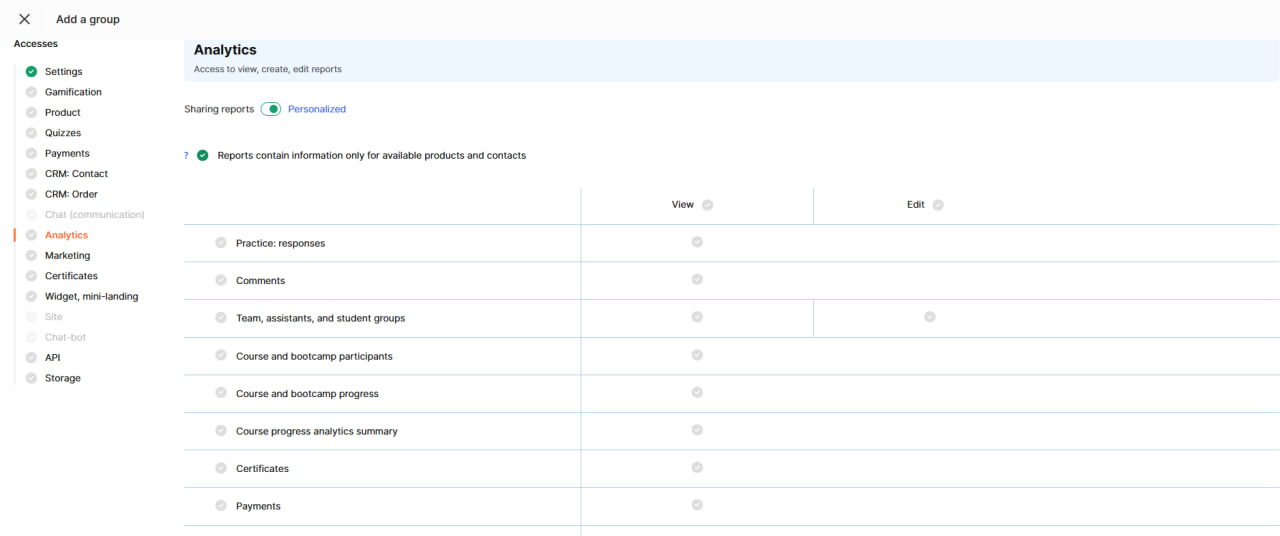
Now, each report in the Analytics section can be managed separately. When editing an access group, you will see a set of checkboxes for specific reports:
-
Assignments: responses
-
Comments
-
Team, curators, and student groups
-
Course and marathon participants
-
Course and marathon progress
-
Consolidated course progress analytics
-
Certificates
-
Payments
-
Transactions
-
Completed webinars
-
Email validation log
For each report, you can separately grant View permission and, where applicable, Edit permission.
There is also a Reports for accessible products only toggle. It does not hide the report itself; instead, it limits what the person can see within it: rows, amounts, filter values, and exports are restricted to products the user has access to. This toggle is already enabled by default for all existing access groups to ensure that no one sees information they should not have access to. If a person needs to see data for the entire dashboard, the toggle can be disabled in the settings of the corresponding group.
What exactly is considered accessible depends on the type of report:
-
For the Assignments: responses, Comments, Course and marathon participants, Course and marathon progress, Certificates reports — these are the products and students the person works with as a curator or course administrator.
-
For the Payments, Transactions, Completed webinars reports — these are the products for which the person has view access.
Therefore, for example, an employee responsible for payments does not need to be assigned as a curator — it is enough to grant them access to the required products, and the payment reports will automatically be limited to those products.
How to grant and configure a user's access to a specific product
If you need to give an individual user access to a particular course, we recommend setting it up through the Courses → Team, Curators, and Student Groups menu.

Read more about adding a curator and configuring their access in a separate article.
Proper access setup will help optimize workflows, minimize risks, and improve team collaboration. Use the capabilities of the Kwiga platform to create a convenient and secure work environment for your entire team.
Didn't find the answer? Contact the support service via online chat or Telegram